

Freight Trucking Market to Reach US$ 3.70 Trillion by 2032, Growing at a 3.9% CAGR | Persistence Market Research
Freight Trucking Market
Freight trucking market expands steadily driven by e-commerce growth, green truck adoption, digital logistics, and rising demand for supply chain transportation
BRENTFORD, LONDON, UNITED KINGDOM, March 2, 2026 /EINPresswire.com/ -- The freight trucking market forms the backbone of global logistics, enabling the efficient movement of raw materials, industrial goods, and consumer products across supply chains. Freight trucking remains essential for first-mile and last-mile connectivity, especially in regions where rail or maritime infrastructure is limited. As global economies expand and trade volumes increase, trucking continues to dominate freight transport due to its flexibility, accessibility, and speed. Rapid urbanization, infrastructure development, and expanding industrial production are strengthening the reliance on road freight services worldwide.
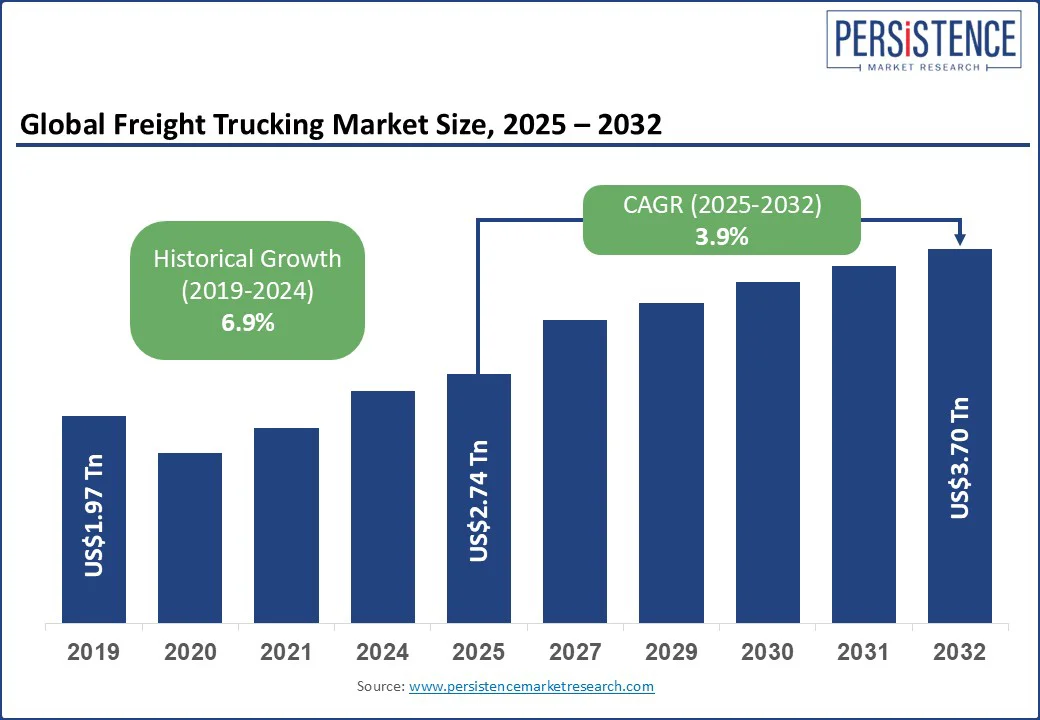
According to analysis by Persistence Market Research, the global freight trucking market size is projected to be valued at US$2.74 Tn in 2025 and reach US$3.70 Tn by 2032, growing at a CAGR of 3.9% during the forecast period. Rising fuel prices and strict emission regulations are accelerating investments in electric and hydrogen-powered trucks, creating long-term transformation in fleet operations. E-commerce growth and the expansion of retail distribution networks are significantly increasing demand for fast and reliable freight transportation. Heavy-duty trucking remains the leading segment due to its ability to transport bulk goods over long distances efficiently. Asia Pacific dominates the market due to expanding industrial output, large population base, and rapidly growing logistics infrastructure supporting domestic and cross-border trade.
Get Your FREE Sample Report Instantly Click Now: https://www.persistencemarketresearch.com/request-customization/35557
Key Highlights from the Report
➤ The freight trucking market is expected to grow from US$2.74 Tn in 2025 to US$3.70 Tn by 2032 at a CAGR of 3.9%.
➤ Rising adoption of electric and hydrogen-powered trucks is reshaping fleet modernization strategies globally.
➤ Expanding e-commerce and last-mile delivery requirements are accelerating demand for flexible freight trucking solutions.
➤ Heavy-duty trucks continue to lead the market due to high payload capacity and long-distance efficiency.
➤ Asia Pacific remains the leading region driven by industrialization, urbanization, and infrastructure investments.
➤ Digital logistics tools and telematics are improving route optimization, fleet safety, and operational efficiency.
Market Segmentation
By Truck Type
• Dry Van & Box
• Refrigerated
• Tanker
• Flatbed
• Others
By End-user Industry
• Retail & E-Commerce
• Industrial & Manufacturing
• Food & Beverages
• Pharmaceuticals & Healthcare
• Automotive
• Oil & Gas
• Chemicals
• Others
By Vehicle Size
• Light-Duty Trucks (LDTs)
• Medium-Duty Trucks (MDTs)
• Heavy-Duty Trucks (HDTs)
By Cargo Type
• Dry Goods
• Perishables
• Hazardous Materials
By Region
• North America
• Europe
• East Asia
• South Asia & Oceania
• Latin America
• Middle East & Africa
Customize This Report for Your Exact Requirements: https://www.persistencemarketresearch.com/request-customization/35557
Regional Insights
Asia Pacific leads the freight trucking market due to its strong manufacturing base, expanding trade networks, and growing domestic consumption. Countries such as China and India are witnessing rapid infrastructure development and industrial growth, increasing freight demand significantly. Urbanization and population growth are further boosting last-mile delivery needs. Government investments in road infrastructure and logistics modernization are enhancing trucking efficiency. The expansion of e-commerce platforms and supply chain networks continues to strengthen regional trucking demand.
North America remains a mature and technologically advanced freight trucking market driven by strong logistics networks and high freight volumes. The presence of advanced fleet management technologies and large logistics companies supports market growth. Increasing adoption of electric trucks and sustainability initiatives is reshaping fleet operations. Europe also shows steady growth due to regulatory focus on emission reduction and green transportation. Strong cross-border trade within the region supports trucking demand. Infrastructure quality and technological integration continue to improve freight efficiency.
Market Drivers
The rapid growth of e-commerce and retail distribution networks is one of the primary drivers of the freight trucking market. Online shopping has significantly increased delivery volumes, creating strong demand for reliable and fast transportation solutions. Businesses are investing in trucking fleets to ensure timely deliveries and maintain customer satisfaction. The growth of omnichannel retail is also increasing transportation requirements between warehouses, fulfillment centers, and retail stores. Freight trucking offers flexibility and speed compared to other transportation modes. This makes it essential for supporting modern retail supply chains and logistics operations.
Industrial expansion and infrastructure development are also driving freight trucking demand globally. Manufacturing growth increases the need for transporting raw materials and finished products efficiently. Infrastructure projects such as highways, airports, and urban development require large-scale material transportation. Freight trucks play a critical role in supporting these activities. Global trade expansion further increases cross-border freight movement. Continuous supply chain activity ensures sustained trucking demand worldwide.
Market Opportunities
The transition toward electric and hydrogen-powered trucks presents significant growth opportunities. Companies are investing in sustainable transportation solutions to meet regulatory requirements and reduce operational costs. Electric trucks offer lower maintenance and fuel costs over time. Hydrogen trucks provide longer range and faster refueling capabilities. These technologies are expected to transform freight transportation. Sustainability initiatives are accelerating innovation and fleet modernization.
Digital transformation is also creating new opportunities in freight trucking. Telematics, artificial intelligence, and real-time tracking systems improve operational efficiency and fleet management. Route optimization reduces fuel consumption and delivery time. Data analytics helps companies improve decision-making and reduce costs. Automation and smart logistics solutions are enhancing productivity. These advancements are improving overall freight transportation efficiency.
Ready to Dive Deep? Buy Full Report Today: https://www.persistencemarketresearch.com/checkout/35557
Recent Developments:
In January 2025, DHL Group expanded its electric truck fleet to strengthen sustainable logistics operations.
In March 2024, FedEx Corporation introduced advanced fleet optimization technology to improve delivery efficiency and reduce fuel consumption.
Future Opportunities and Growth Prospects
The future of the freight trucking market will be shaped by sustainability, digitalization, and supply chain transformation. Investments in electric and hydrogen truck technologies will continue to accelerate fleet modernization. Infrastructure development and global trade expansion will sustain freight demand. The integration of artificial intelligence and automation will improve logistics efficiency and reduce operational costs. Emerging markets will play a crucial role in supporting future growth. As logistics networks expand and modernize, freight trucking will remain a vital component of global transportation systems.
Persistence Market Research
Persistence Market Research Pvt Ltd
+1 646-878-6329
email us here
Visit us on social media:
LinkedIn
Instagram
Facebook
YouTube
X
Legal Disclaimer:
EIN Presswire provides this news content "as is" without warranty of any kind. We do not accept any responsibility or liability for the accuracy, content, images, videos, licenses, completeness, legality, or reliability of the information contained in this article. If you have any complaints or copyright issues related to this article, kindly contact the author above.
